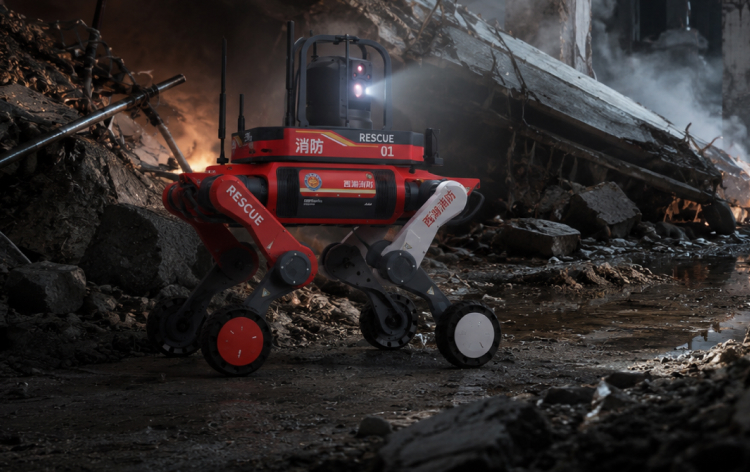
M20 Emergency Reconnaissance Wheeled Solution
The M20 emergency reconnaissance wheeled solution uses a wheeled-leg robot with dual-spectrum PTZ, gas sensors, ad-hoc networking and 5G communications for fire rescue, incident reconnaissance, hazardous environments, rubble search and complex space inspection.
With a composite metal body and onboard battery, M20 supports long-range wireless control and live video transmission. Its mobility reaches narrow spaces, rubble and incident sites—replacing personnel in high-risk zones for search, sensing and information relay to command.
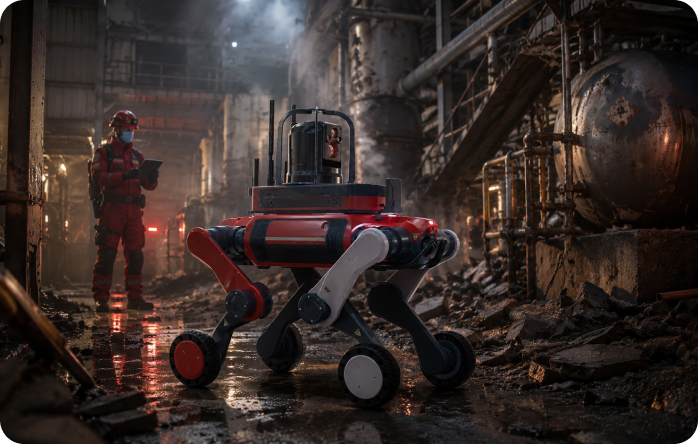
The platform offers strong mobility with up to 45° slope climbing, 25 cm continuous steps, omnidirectional avoidance, surround LiDAR, dual-direction lighting and hot-swappable batteries for complex, confined unstructured sites.
Dual-spectrum PTZ, gas sensing, mesh and 5G enable forward video reconnaissance, thermal imaging, long-range zoom, gas risk detection and communications relay. Visible light offers 33× optical zoom; thermal imaging covers -20°C to 550°C; gas sensors detect CO, H₂S, O₂, combustibles, CO₂, NOx and more for decision support.
M20 Emergency Reconnaissance Wheeled Solution
The M20 emergency reconnaissance wheeled solution uses a wheeled-leg robot with dual-spectrum PTZ, gas sensors, ad-hoc networking and 5G communications for fire rescue, incident reconnaissance, hazardous environments, rubble search and complex space inspection.
With a composite metal body and onboard battery, M20 supports long-range wireless control and live video transmission. Its mobility reaches narrow spaces, rubble and incident sites—replacing personnel in high-risk zones for search, sensing and information relay to command.
The platform offers strong mobility with up to 45° slope climbing, 25 cm continuous steps, omnidirectional avoidance, surround LiDAR, dual-direction lighting and hot-swappable batteries for complex, confined unstructured sites.
Dual-spectrum PTZ, gas sensing, mesh and 5G enable forward video reconnaissance, thermal imaging, long-range zoom, gas risk detection and communications relay. Visible light offers 33× optical zoom; thermal imaging covers -20°C to 550°C; gas sensors detect CO, H₂S, O₂, combustibles, CO₂, NOx and more for decision support.